Somatics and the stress response
“Remember you are water. Of course you leave salt trails. Of course you are crying. Flow.
 P.S. If there happens to be a multitude of griefs upon you, individual and collective, or fast and slow, or small and large, add equal parts of these considerations: that the broken heart can cover more territory. That perhaps love can only be as large as grief demands. That grief is the growing up of the heart that bursts boundaries like an old skin or a finished life. That grief is gratitude. That water seeks scale, that even your tears seek the recognition of community. That the heart is a front line and the fight is to feel in a world of distraction. That your grief is a worthwhile use of your time. That your body will feel only as much as it is able to. That the ones you grieve may be grieving you. That the sacred comes from the limitations. That you are excellent at loving.”
— adrienne maree brown, Emergent Strategy: Shaping Change, Changing Worlds (2017)We live in a time of constant stimulation, pressure, and uncertainty. From global instability to the everyday demands of work, caregiving, and financial strain, many of us live in a near-constant state of activation. While short bursts of stress can be motivating, repeated exposure without enough recovery time can gradually wear down our systems. Understanding how the stress response system works can help us to recognise what’s happening in our bodies, and why completing the cycle of stress is supportive for our long-term health and wellbeing.
Stress is systemic
Below, we’ll share some of the core science and somatics that underpin our approach to stress prevention and recovery at Collective Being. First though, we’d like to emphasise that individual care practices, whilst important, do not and cannot be expected to relieve the weight of systemic and structural stressors. Our bodies respond not only to what is personal, but also to political, relational, and historical stressors. Acknowledging this truth brings dignity to our stress, sometimes providing an ‘aha’ moment, i.e. - “of course I feel stressed right now - that is a logical response to this moment in time”.
Likewise, if you are currently experiencing chronic stress, trauma, or retraumatisation, this information may be helpful and/or interesting, but won’t be an adequate substitute for therapeutic support. If either of these considerations apply to you, we send you love and care. If the themes of this email resonate with you, you might be interested in exploring trauma-informed somatic therapy, where a qualified and skilled practitioner can support you step-by-step to deepen your relationship with your body and nervous-system awareness, and guide you through tailored somatics practices relevant to your experiences.
The science of stress
Stress is a complex, biopsychosocial experience shaped by our relationships, histories, and the systems we move through. In a world of compounding pressures, from climate collapse and systemic racism to insecure housing and the quiet grind of work and caregiving, many of us adapt by staying in motion.
Our bodies are able to keep going during times of stress due to what Hans Selye called adaptation energy and what psychologist Ann Masten more recently named surge capacity: the short-term survival energy that helps humans to function during times of acute stress.
Survival energy is a remarkable capacity, but it is finite. When it begins to run low, the nervous system loses its flexibility and stress hormones deplete. This wear and tear has a name: allostatic load. It describes the cumulative cost of adapting to stress without enough rest or repair, and helps explain why we often feel stretched thin even when a crisis has technically passed. Allostatic load can have significant health impacts, and over time can contribute to:
Sleep disruption
Hormonal imbalances
Weakened immunity
Cardiovascular strain
Increased inflammation
Cognitive changes (e.g. difficulty concentrating or remembering).
The stress response cycle
In order to avoid allostatic load, we need to understand how our bodies innately respond to and metabolise stress. The stress cycle is a biological sequence that helps the body recognise, respond to, and recover from stress. It includes four key phases:
Alarm
Activation
Deactivation
Restoration
Each of these four phases involves specific systems in the body, including the brain, nervous system, and hormonal pathways. Without conscious awareness, it is really easy for our bodies to become stuck in activation states - especially when stress is prolonged.
Recovery is cumulative
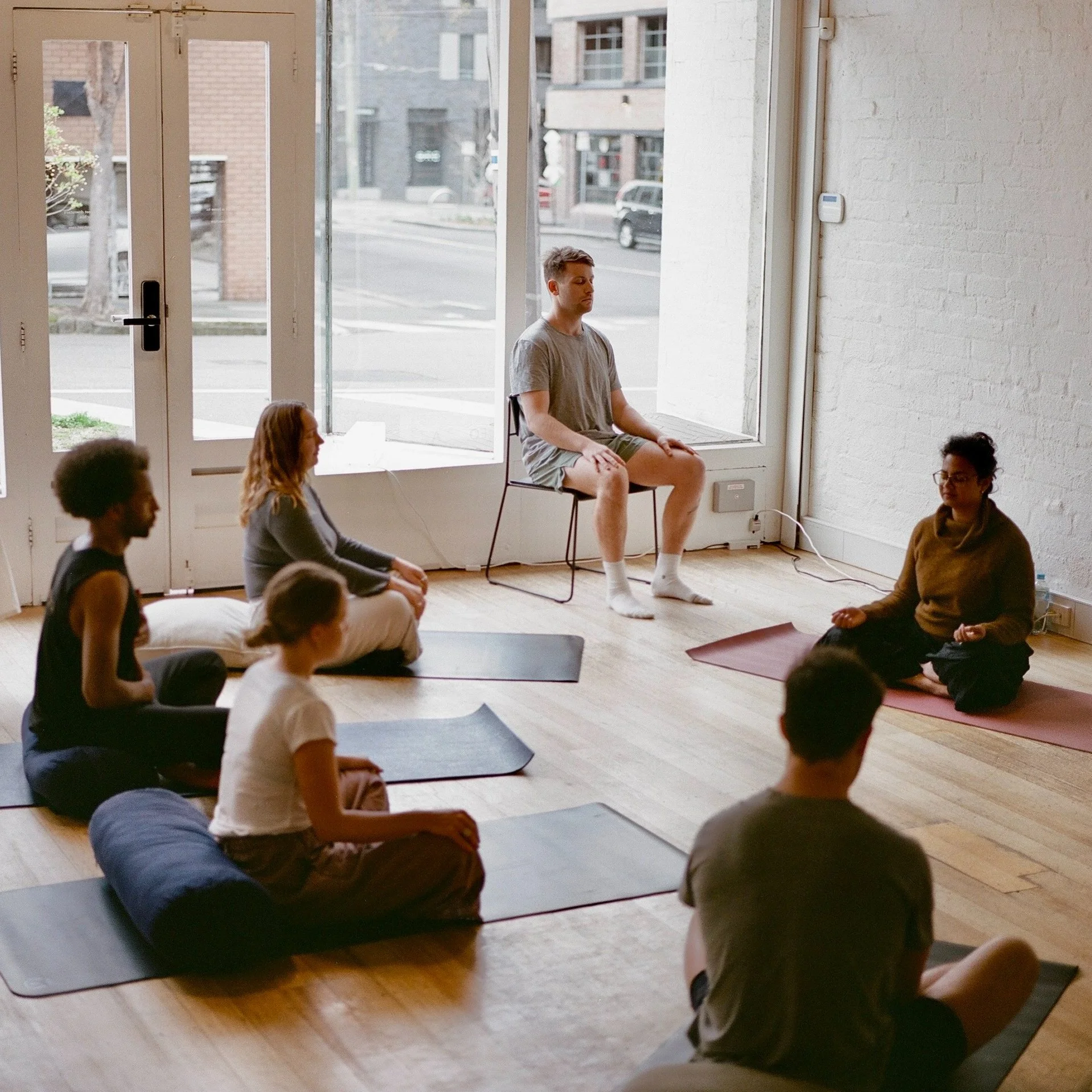
Somatic practices reduce stress symptoms by calming activation in real time, i.e. through settling or grounding. They can also support recovery by shifting the body from activation to deactivation, restoring balance. When integrated into our daily lives with intention, somatic practices can transform stress from something that gets stuck into something the body can move through and metabolise.
In our programs, whether in hospital wards, neighbourhood houses, or classrooms, we practice small, repeatable somatic acts that support the process of settling and recovery. Sometimes it’s a simple breath, a gentle shake, or a quiet moment with a hand resting on the chest. Sometimes it’s the shared exhale of a group, a shared cup of tea, or a shared laugh. Generally, we teach that embodiment doesn’t always feel good, calm, or better - especially in times of high stress. We reframe our practices as ‘inquiries’ as opposed to solutions. Our goal is to retrain our interoceptive (felt) sense, so that we can make embodied choices when stress is prolonged or overwhelming.
At its core, somatics is a practice of repetition. Guided by the insight that ‘we are what we practice the most’, somatics encourages us to practice listening and responding to our inner worlds with compassion and care, as frequently as we can. With time, repetitive practice can create new neural pathways and new ways of being, enabling us to relate to stress in a more timely and responsive way.
A practice for this moment
If you’re reading this and feeling stretched thin, we invite you to try one small practice. This could be:
Stepping outside and taking a moment to absorb light, sound, temperature and other sensory stimuli.
If you are inside, you could take some time to rock or sway your body, loosening joints and muscles. Or perhaps, take a minute or two to stretch your arms and legs.
Focusing on breath if that is available, you could take your smoothest breath of the day.
With care,
Jo (Director of Collective Being)